
The 1599 Globe and its modern replica: Virtual Reality modelling of the archaeological and pictorial evidence [1]
The International Shakespeare Globe Centre (ISGC) replica theatre known as 'Shakespeare's Globe' currently standing in south London was designed to be the best scholarly approximation of the building constructed by Peter Street from the reclaimed timbers of the Theatre in Shoreditch that was disassembled by its owners and removed to a newly leased site on Bankside in December 1598 and January 1599. Two key pieces of evidence about the size and shape of the 1599 Globe have come down to us: a sketch made by Wenceslaus Hollar in preparation for his 'Long View of London' engraving published in 1647, and the foundations of the building (now under Anchor Terrace on Southwark Bridge Road). The Hollar sketch--reproduced in Tim Fitzpatrick's article in this issue of EMLS--shows the second Globe, built after a fire destroyed the first Globe in 1613, but because building regulations enforced the reuse of the original foundations the second Globe must have had the same groundplan, and hence the same size and shape, as the first Globe. Thus evidence of the second building tells us of the first. Those foundations were uncovered by a team from the Museum of London Department of Greater London Archaeologyl (MoL-DGLA) in 1989-90 and drawings published in paper form. At that time, the academic committee of the proposed 'Shakespeare's Globe' reconstruction was meeting to finalize the size and shape of the building and John Orrell's interpretations of the evidence won the committee's approval, although there were notable demurrals by Franklin J. Hildy and Martin Clout. The essence of Orrell's interpretation was that the Globe was a 20-sided polygon 100 feet in diameter, measured 'across the points', and the reconstruction was built to that specification. This paper revaluates the interpretation of the evidence that led Orrell to his conclusions and applies techniques of computer modelling in order to corroborate the original findings made using paper and ink, translucent cels, and trigonometric calculation. Although the evidence of Hollar's sketch was available before the evidence from the foundations, they will be taken in reverse order here (foundations, then Hollar sketch) because the principles of modelling in relation to the foundations are considerably simpler than those applied to the sketch.
The Globe Foundations
In advance of commercial development of the land upon which the Rose playhouse had stood the Museum of London began excavation in December 1988. During early February 1989 the remains of the Rose emerged and were, after considerable controversy, non-destructively excavated [2]. Orrell and Andrew Gurr were the first into print with a provisional evaluation of the site [3]. The uncovered remains showed the original configuration of the building and the result of the extensive alterations made in 1592, known from the expenses recorded by Henslowe [4]. In February 1990 Franklin J. Hildy called an academic conference at the University of Georgia to assess the discoveries made from the uncovering of the remains of the Rose. Julian M. C. Bowsher and Simon Blatherwick, who led the archaeological team working on the Rose site, presented their findings, which confirmed the deviations from expectation suggested by Orrell and Gurr's preliminary examination [5]. While the conference was being planned a second team from the Museum of London began working on the site of the first Globe and on 12 October 1989 they announced discovery of part of the Globe foundations. At the conference Orrell presented his considered response to the evidence from the Rose and his preliminary examination of the evidence from the Globe [6]. The Globe remains appeared to be part of the foundations of the outer wall and one stair turret. The location of this turret, on a radial about 60 degrees east of north, matched neither of the turrets shown by Hollar, and it was 50% wider than it should have been [7]. Orrell admitted that these anomalies threw doubt on Hollar's representation of the orientation of the Globe, but drew comfort from the fact that the turret was centred on an angle of the main frame wall, as he expected, although Richard Hosley's work on stair turrets made the opposite assumption that they should abut the middle of a bay wall [8].
-
Orrell attempted to measure the angles and dimensions suggested by the scant remains, and from them determine the size and shape of the Globe. Assuming that the Globe was a regular polygon--an assumption made less safe by the Rose remains--the few measurable angles and dimensions in the Globe remains suggested a 20-sided polygon with a diameter of very nearly 100 feet [9]. The ground floor galleries were 12½ feet, or 12 feet 8 inches deep if measured radially, which is some 3 feet less than we would expect from the ad quadratum method that Orrell believed was Peter Street's usual method of working [10]. Ad quadratum geometric progression works by inscribing a circle around a given square and then producing a further square from four tangents of this circle. The ratio of the widths of the two squares is 1 to the square-root of 2 and the ratio of the areas of the two squares is 1 to 2, and these ratios govern the two squares (one 56 feet 1 inch square, the other 79 feet 2 inches square) that formed the yard and outer wall of the Fortune playhouse built by Street one year after building the Globe [11]. This correspondence strongly suggests that Street used the ad quadratum method. Turning to the Rose remains, Orrell pointed out that the publicity drawing issued by the Museum of London and reproduced in his earlier article [12] overstated the irregularity of the remains and rather too emphatically imposed a conjectured groundplan in areas that had not been dug [13]. A more recent drawing showed greater regularity and was consistent with use of the ad quadratum method in laying the groundplan for the original 1587 construction [14]. Irregularity in the initial construction would be difficult to reconcile with the evidence that 'framing', the prefabrication of the timber frame, took place off-site and hence detailed plans were agreed so that the laying of foundations and prefabrication of the frame could proceed concurrently in different locations.
Applying the evidence of the Globe remains to the project in hand, Orrell accepted that the Globe could not have been laid out ad quadratum but nonetheless it could have been constructed using a surveyor's standard three-rod line if geometric pre-calculation were used to derive the correct length for each bay's outer wall [15]. Orrell advised against acting upon this subjective response until further consideration of the evidence had taken place. The ISGC decided to build two experimental bays based on Orrell's tentative response to the evidence of the Globe remains, assuming that the original had 20 gallery bays each 12½ feet deep, the overall diameter being 100 feet across points [16]. Orrell had concluded that this was not an ad quadratum design since the diameters of the circles within which are inscribed the inner and outer polygons of the groundplan were not in a 1-to-root-2 relation. But the workshop experience of Peter Curdy, the timber-frame construction expert contracted to make the reconstruction, suggested that the wall plate frame would be fabricated at the same time as the ground sill frame, and that Peter Street would have considered the proportions of the former, which defined the dimensions of the uppermost gallery bay, to be just as important as those of the ground sill frame. If there was a jetty -- the "Juttey-forwardes" of the Fortune contract [17] -- of 12 inches in each of the two elevated bays, the uppermost gallery bay could be brought into an ad quadratum relationship with the overall diameter. During 1991 more of the Globe remains were uncovered and Blatherwick and Gurr published their revised conjectures; if anything the evidence uncovered in 1991 increased the uncertainty about the design of the first Globe because foundations were uncovered that could not easily be related to those already known [18].
From the angular foundations Blatherwick and Gurr attempted to extrapolate the shape of the polygonal playhouse. An ad quadratum pair of concentric circles could be made to touch several of the remains if the outer circle had a diameter of 80 feet [19]. Alternatively, by projecting lines from the fragments of radials in the remains, the centre of the playhouse where these radials meet could be established; this method yielded a 100 feet diameter [20]. Such a small proportion of the remains could be reached without violating the agreement with English Heritage (who had a duty to protect the overlying building, Anchor Terrace) that Blatherwick and Gurr wondered if the scheduled area believed to contain the Globe remains was large enough. So ambiguous were the remains that perhaps the wrong piece of land was being protected [21], and Clout published an article claiming that this was indeed the case [22]. In a response to Blatherwick and Gurr's work, which was printed at the end of their article, Orrell rejected the attempt to fit the remains into circular patterns. Orrell pointed out that the foundations would support a polygonal building, not a circular one, and that the proper method was to try to fit the remains into triangular patterns [23]. Blatherwick and Gurr's 80 feet configuration made a very poor fit when constructed as a polygon, and at best it produced an unlikely 11-sided playhouse. Orrell measured the least damaged angle in the foundations, apparently part of the inner gallery wall, as 162 degrees, which indicated a 20-sided playhouse [24]. If the playhouse was about 100 feet across, as Orrell had long believed, the 20-sided configuration could, he claimed, be made to fit extremely well with the uncovered remains [25].
The two experimental bays built by ISGC in 1992 reflected Orrell's latest thinking: a 20-sided Globe of about 100 feet external diameter. Hildy summarized Orrell's work and the building project in an article that drew attention to what he considered to be an important flaw in the former, and therefore the latter [26]. Hildy noted that Orrell's projections were based on a drawing of the Globe remains that was published by the Museum of London for the purposes of clear reproduction, but which was less accurate than the original drawings made on site [27]. Hildy acquired the original drawings and applied Orrell's method to them; he found that the angle measured by Orrell as 162 degrees was, to his eye, 160 degrees, and that other measurements were also significantly adrift. Hildy's use of Orrell's method upon the original drawings produced an 18-sided Globe of about 90 feet across [28]. To collate the scholarly responses to the evidence of the Globe remains and the experimental bays, ISGC called a one-day seminar on 10 October 1992 at the offices of the project's architects, Pentagram Design in London. At the seminar Orrell summarized his work on the Globe remains and indicated his acceptance of Hildy's argument that the published diagrams were inadequate by showing a new diagram that Hildy had obtained by photocopying the original drawings from the Museum of London archive. Orrell demonstrated that even this photocopy was subject to distortion introduced by the copying process, but the use of overlaid metric graph paper enabled this distortion to be measured and allowance made [29].
There followed a 'Cinderella' procedure in which competing polygonal configurations, some brought by delegates and others derived from published works, were laid over the diagram of the Globe remains to see which fitted best. Apart from Orrell's proposed configuration, the closest fit was an 18-sided 90 feet diameter construction offered by Hildy. This appeared to fit perfectly until distortions in the underlying drawing of the remains and the overlaid drawing of the configuration were compensated for, at which point an implausible discrepancy emerged [30]. Orrell's 20-sided 99 feet configuration, on the other hand, fitted perfectly in every respect. Hildy responded that all reproductions of the original drawings introduce distortion and that the only reliable method was to count the grid squares on the originals and proceed by trigonometric means to derive the angles. This Hildy had done and found in favour of his 18-sided 90 feet diameter playhouse [31]. Gurr, as chair of the meeting, called for delegates to set aside subjective feelings about whether a 100 or 90 feet diameter was typical or appropriate and asked them to vote on whether the project should adopt Orrell's or Hildy's plan. Orrell's design won by 14 votes to 6 [32].
In 1999 the Museum of London Archaeological Service (MoLAS, successor of the MoL-DGLA for our purposes) supplied this author with its final version of the drawing of the Globe foundations, and as is usual these days it took the form of a computer file in the format used by the industry-standard Computer Aided Design (CAD) software package called AutoCAD. The precision with which measurements can be specified in AutoCAD far exceeds what can be achieved with even the highest quality ink and paper drawings, and the software can be instructed to perform complex mathematic calculations based on the objects that are represented in its drawings. Indeed, as the objects represented in an AutoCAD 'drawing' are stored with their dimensions recorded in any unit system the operator cares to specify, and because the 'drawings' can contain information about all three dimensions of an object, these 'drawings' are not really drawings at all (a term that carries an implication of a simple scale ratio between represented and representing entities) but rather models of the objects they represent. If the operator chooses to enter information about just 2 of the 3 possible dimensions, the resulting file looks like a 2-dimensional drawing, but is in fact essentially an accurate model of a paper drawing of the objects. The computer file supplied by the MoLAS is composed of several virtual layers, each containing information about a different kind of material found on the site. Thus one layer (colour coded white) showed the chalk remains found, another (colour coded blue) represented concrete, and another still (colour coded cyan) represented flint remains. Within AutoCAD the operator can elect to see several or all of the layers at once, and once the detail starts to build up it becomes clear that the colour coding scheme is necessary to prevent mistaking one kind of material remains for another; the simple black-and-white representations of traditional archaeological drawings are considerably more difficult to make sense of in this regard.
-
As most EMLS readers will not possess the AutoCAD software needed to read the file supplied by MoLAS [33], the images shown here are 2-dimensional colour graphics exported from AutoCAD and using the colour-coding scheme created by MoLAS with slight modification. Figure 1 is a graphic representation of the MoLAS model in which the layers called 'bricks' and 'robber', which represent the foundations made in 1599 to support the Globe playhouse, have been rendered in yellow for high visibility.
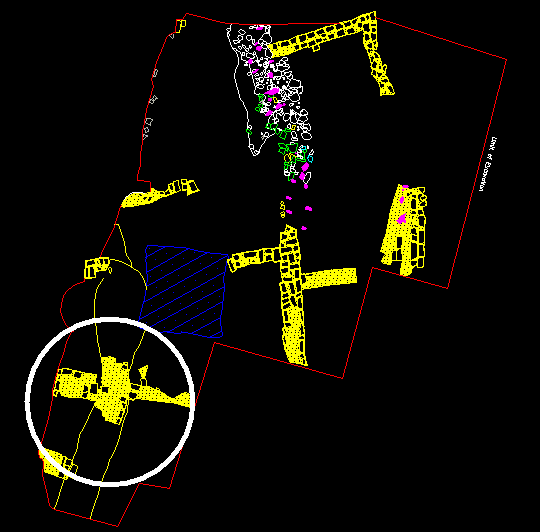
(Figure 1. Graphic representation of the MoLAS AutoCAD drawing of ACT-89 excavation, Globe Theatre foundations, Southwark Bridge Road, London SE1)
The white circle, added by the author, encompasses the area around the angle measured by Orrell as 162 degrees and Hildy as 160 degrees, which would give a polygon whose each corner was, respectively, 18 degrees and 20 degrees less than a straight line (of 180 degrees), and hence a 20-sided (360 / 18) or 18-sided (360 / 20) Globe. It is clear that any attempt to measure this 'angle' is hopeless: lines can be said to meet at an angle, but this is merely the intersection of two blobs.
Computerization is of no special help with the data inside the white circle, since any number of angles between about 150 and 170 degrees could be made to lie upon this 'knuckle joint' of the foundations, corresponding to buildings of between 12 and 36 sides respectively. But taking the graphic as a whole, or rather the AutoCAD model from which it is derived, it is possible to repeat the 'Cinderella' process undertaken at the Pentagram meeting of 10 October 1992, using computer models instead of the allegedly distorted photocopied cels then available. To this end, the author built an AutoCAD model of the International Shakespeare Globe Centre replica (the building called 'Shakespeare's Globe') with a view to combining it with the MoLAS model of the foundations: if the building that was constructed in the 1990s fits on the foundations of the 1599 building, we may say that the scholarship of the reconstruction is vindicated. The author's model exploited AutoCAD's ability to model 3-dimensional solids and it should be remembered that the pictures shown in this paper use lines to represent the edges of solids, but the model is no wire-frame: each structural timber is defined as a solid object with density.
-
In the event a number of difficulties were encountered in merging the author's model of the modern building with the MoLAS model of the 1599 foundations, not least of which was the architect and timber-frame constructors' use of feet and inches in their plans and the archaeologists' use of metres. With the appropriate scaling, applied, however, the models were merged and allowed to occupy different layers within a single new, composite model so that the computer could perform--to a much higher degree of accuracy than achievable with photocopy cels--the sliding of the new building onto the old foundation. The final siting of the building in respect of the foundation was, of course, achieved by manual rotations and translations of the layers containing the building and the foundation. Figure 2 represents the best possible alignment of the foundations (slightly rotated from Figure 1) with the building, represented only by its brick footings.
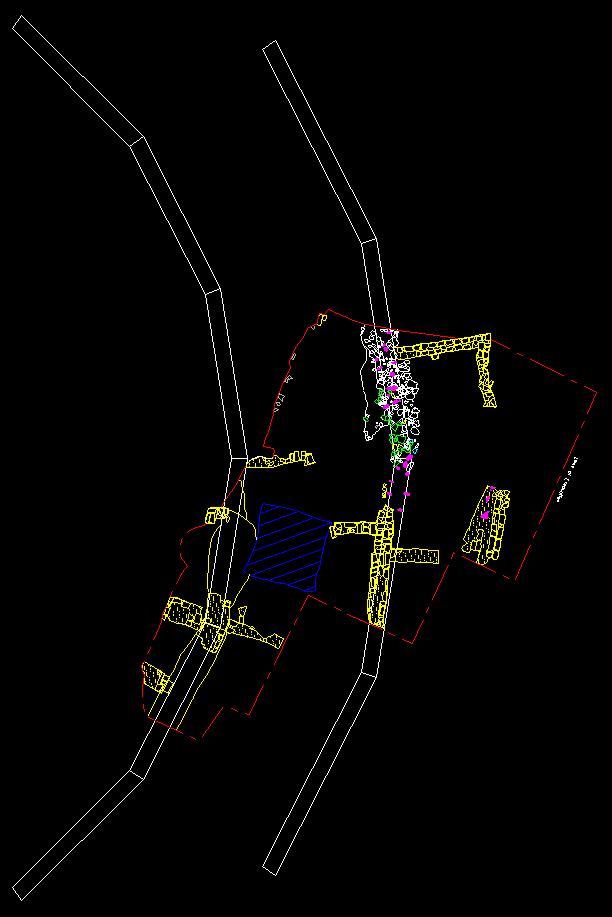
(Figure 2. The 1599 Globe foundations underneath the brick footings (shown as white rectangles) of ISGC Globe reconstruction)
It can be seen from Figure 2 that the Globe replica fits reasonably well on the 1599 foundations, although far from perfectly. Importantly, it is clear that had the replica been made with fewer sides (as Hildy recommended), the fit would have been improved in certain areas but made worse in others. For example, what I have called the 'knuckle joint' (circled in white in Figure 1) comprises an area of brick (filled in by semi-solid yellow in the figures) where two flats of the inner playhouse wall seem to meet, and extending from this intersection two rather less orderly areas (picked out by yellow lines, not filled) where brick once was, now robbed out. On close inspection the brick part of the 'knuckle joint' seems somewhat more acutely angled than the replica's footings (nearer to Hildy's 160 degree, 18-sided design), but if the robbed out area represents how these original foundations extended from that intersection, anything more acute than the 162 degree angle of the replica would not sit comfortably on the original foundations. On the other hand, the 'dog leg' intersection to the right of the 'knuckle joint' (about 2 inches right across your computer screen and 1 inch up) would seem to better support a more acutely angled playhouse wall than it does the wall of the replica that has been built. While there can be no certainty in this matter, I would judge that the evidence from the excavation of the foundations is compatible with the ISGC Globe replica, but it is also compatible (and, arguably, a shade more compatible) with at least one of the alternative designs that were rejected. With this is mind, we can turn to a revaluation of the arguments by which Orrell steered the academic committee of ISGC towards his favoured design (a 20-sided polygon, 100 feet across) and in particular his brilliant interpretation of Hollar's preparatory sketch for the 'Long View of London'.
Hollar's topographical glass and the 'Long View'
-
On the last page of an early article on the evidence of Peter Street's timber framing practices Orrell made the tantalizing comment that he had "developed a new way of measuring from Hollar's sketch" [34]. Orrell presented his ground-breaking work at a symposium held at Wayne State University in Detroit to discuss reconstruction of the second Globe [35]. The key to the new approach was a reconstruction of the method Hollar used to make his preliminary sketches. Orrell noticed that the companion piece of the view of Southwark, a view looking eastward towards Greenwich, lacked artistic organization and he wondered if this could be due to the use of an instrument called a 'topographical glass', which would produce almost photographic accuracy at the expense of beauty. The proper test of this hypothesis in respect of the Southwark view required that Orrell locate at least four landmarks in the sketch that could also be located on a reliable modern map of the same area of London. Lines were drawn on the map from the vantage point, the tower of St Saviour's church (now Southwark Cathedral), to each of the landmarks and beyond. If the three intervals between four landmarks on the sketch could be lined up with the intervals between these four radiating lines on the map this would prove that Hollar's sketch was constructed using a drawing frame [36]. In the event Orrell was able to line up five landmarks in this way and he emphasized that this indicated an accuracy far beyond the reach of artistic judgment:
. . . the precision here is entirely a matter of rendering a plane intersection of the visual pyramid. He is not putting down on paper a simple record of the relative distances apart of the landmarks as seen radially from his point of view. Such a landscape presupposes a more or less segmental arc of intersection and results in intervals quite different from those yielded by the plane intersection [37].
Orrell's method of lining up the landmarks in the sketch with the radials drawn on a map from the vantage point to those landmarks not only established the accuracy of the Hollar sketch, but also yielded a precise figure for the scale. Since the sketch represents a picture plane which intersects the radials from the landmarks at a given angle (the angle to which the sketch had to be turned to make all the landmarks line up), an imagined slice through a given landmark at the same angle relative to north would be simply a scaled up version of that landmark's image in the sketch. If the distance between that landmark and the tower of St Saviour's is known then the principle of similar triangles will yield the width of the imagined slice through the given landmark. Orrell demonstrated his method using scale drawings but performed his calculations using trigonometry [38]. Since the distance between St Saviour's and the Hope and Globe theatres is known, because their locations have been determined, the Hollar sketch yields the real dimensions of the playhouses. After an allowance for anamorphosis -- a distortion unique to circular objects such as columns and amphitheatres far from the centre line -- Hollar's sketch tells us that the Hope was 99.29 feet wide and the Globe was 103.35 feet wide. Orrell calculated the margin of error in the sketch using landmarks of known size and found it was ±2%. Rather than assume that the Hope and Globe were different sizes, Orrell decided that they had a common width of about 101 or 102 feet [39].
Orrell extended this work in The Quest for Shakespeare's Globe [40]. Orrell was clearly aware of the contradiction between his work on ad quadratum based on the Elizabethan surveyor's three-rod line and his measurement of the second Globe as 103.35 feet wide ±2%. In the book Orrell provided the arithmetical detail absent from the earlier article and, although his allowance for the distortion of anamorphosis remained 3.64%, his final figure for the width of the Globe was revised down to 102.35 feet ±2% [41]. The reason for the reduction by 1 foot was that Orrell had earlier believed the Hollar sketch to be 0.306m wide [42] but later revised this to 0.309m [43]. As before, Orrell used the margin of error in Hollar's sketch, ±2%, to argue that the Hope and the Globe were probably the same diameter of "a few inches over a round 100 ft" [44]. In support of this Orrell offered an analysis that suggested that the engraving that Hollar made from the sketch shows a conscious effort to compensate for the anamorphic distortion, which affects the Globe more than the Hope, in order to make them appear to be the same size. Orrell believed the "inveterate sightseer" knew the Hope and Globe to be the same size and wanted to articulate this fact in the engraving even though the sketch, because of its method of construction, tended to obscure it [45]. The heights of the buildings cannot be accurately measured from the Hollar sketch because the bases of both playhouses are obscured by other objects and the point where the walls meet the ground cannot be determined. Making a rough estimate of where the bases should be, Orrell found the heights of both playhouses to be approximately 32 feet, which is close to the presumed 33 feet of the Fortune [46]. Although Orrell gave a new single figure for the width of the Globe as measured from the Hollar sketch, the variation in the ink lines on the paper allowed a range of measurements which result in a range of calculated widths, from a minimum of 101.37 feet to a maximum of 103.32 feet [47]. To each of these can be applied the ±2% margin of error found in other landmarks in the sketch, and so Orrell was able to reconcile this work with his research on ad quadratum practices. If the margin of error is applied to the lower figure it is possible to imagine a Globe that is 99 feet between post centres, and 100 feet from outer wall to outer wall, which was the size suggested by the use of ad quadratum progression from a stage 49½ feet wide [48].
-
It is now possible to check Orrell's analysis of the Hollar sketch by modelling in a computer the salient aspects of the supposed method of its creation. The method by which the sketch was made is carefully described by Orrell thus:
. . . the stylus can be treated almost like the sight of a gun. Looking across its tip at some distant landmark, the artist registers the point where his line of sight crosses the intervening glass. Let us assume that he is drawing the outline of the view directly onto the glass: as he moves his eye to-and-fro behind the stylus in order to mark the alignments of objects to the left and right of the prospect, so the drawing he makes will appear to depart from the actual view he sees if he simply looks directly at it.
. . . precise bearings can readily be taken, as the reader may ascertain for himself if he will set up some sort of stylus 9 in. in front of his window--an unfolded paper clip will do, held between the pages of a book--and with a felt pen trace the outline of the view outside point for point on the glass. In doing so he will, I believe, be reconstructing the essentials of Hollar's method; and he will not fail to be struck by its potential for the most accurate recording of a topographical prospect [49].The reader is encouraged to try the experiment that Orrell described: the resulting pattern of dots on the window will indeed be an accurate representation of the distant objects, but not at all like a perspective drawing. To test that this was indeed how Hollar's sketch was made, or to put it another way, that the ISGC Globe (built to Orrell's specifications derived from his interpretation of the Hollar sketch) is the right size, the author used his 3-dimensional model of the ISGC Globe. A sketch, made inside a computer model, produced by the method Orrell described and using as its object the 3-dimensional model of the Globe already in existence should -- if Orrell's scholarship is correct -- look like the extant Hollar sketch. If it does not, the Hollar sketch was not made the way that Orrell described, or it was made that way but Orrell slipped somewhere in his interpretation of it and the Globe was in fact not 100 feet across.
We do not need to recreate the entire sketch, just the sighting lines that gave Hollar the width of the Globe that he drew, for the diameter of the building is the disputed dimension. The procedure was as follows. The 3-dimensional Globe in the model was placed on the X-Y plane (so the bottom of its sills were at zero in the Z dimension), which is in effect the 'ground level' of Southwark. Along this ground a line was drawn from the centre of the Globe to one of the building's 20 corners and on a further 1181.683 feet, which is the known distance from the 'knuckle joint' in the above figures to the bottom of the tower of Southwark Cathedral where Hollar stood. The known bearing of the 'knuckle joint', measured from a compass on St Saviour's tower, is 280.5 degrees, so counting anti-clockwise 280.5 degrees from the end of this line another line was drawn and labelled 'north'. (Thus, measured clockwise from north as archaeological angles are, the Globe stands at the end of a line bearing 280.5 degrees -- or just north of west -- and 1181.683 feet distant.) At the end of the line opposite from the Globe, that is at the St Saviour's end, a vertical line (that is, one perpendicular to the X-Y plane) was drawn to a height of 144.357 feet, the known height (relative to the ground on which the Globe rested) of the platform on which Hollar stood [50]. The point at the top of this line represents the stylus of Hollar's topographical glass, 1181.683 feet distant (measured along the ground) from the Globe and 144.357 feet above it. A vertical plane representing Hollar's sketch itself was modelled at a distance from the stylus (measured in the X-Y, the horizontal, plane) of 8.917 inches along a perpendicular of the plane. (8.917 inches equals 226.49 mm, which Orrell established as the distance between stylus and paper required by the bearings of the other five buildings). To model Hollar's sighting of a point on the distant object and marking it on the sketch, it is only necessary to draw a straight line from the stylus to that point on the distant object (here, the Globe model) and to note where this line intersects the plane. Finding the coordinates of the intersection of a plane and a line that pierces it is just the kind of work that computer modelling software performs easily and accurately. The modelling described in this paper was performed in 3 dimensions and VRML versions of the Globe and Hollar's instrument are available from the author. But in the 2-dimensional pictures that follow, the 3-dimensional Globe model is seen from a bird's-eye view and its essential details have been removed to leave only a circular outline. Although the footings of the 1599 Globe and its 1613 replacement were polygonal -- a fact that must condition our understanding of the foundations -- the exterior surfaces were rendered to give the appearance of a solid stone circle [51].
-
The 1181.683 feet line from the 'knuckle joint' to the bottom of South Cathedral tower is a simple linear distance, but how does it relate to the rest of the building? That is to say, would this line from St Saviour's to the 'knuckle joint' continue on to the centre of the Globe (as it would if it lay on a radial of the playhouse 'circle') or would the bulk of the playhouse lie to the left or right of such a continuation? The question is illustrated in Figure 3.
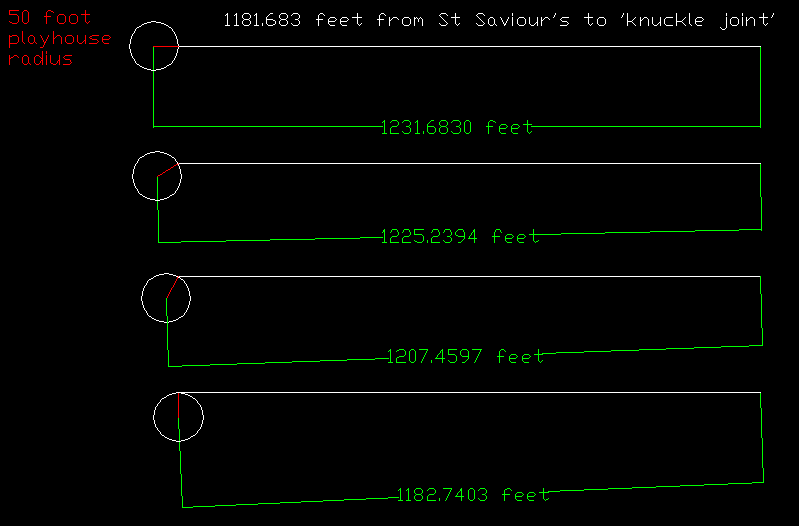
(Figure 3)
In each illustration within Figure 3, the white circle represents a Globe playhouse 100 feet in diameter and the white horizontal line the 1181.683 feet along the ground from St Saviour's tower to the 'knuckle joint' in the previous figures. In the first illustration, the 'knuckle joint' happens to be precisely on a radial ('3 o'clock') from the centre of the playhouse to St Saviour's, so the playhouse radius is simply added to the distance to St Saviour's and thus the centre of the Globe is 1231.683 feet from St Saviour's. Because the Globe is 280.5 degrees (roughly west) of St Saviour's tower, and given the geometry of the foundations in Figure 1, it is not hard to imagine that what has been uncovered is indeed the corner of the playhouse nearest to St Saviour's and hence a 1181.683 feet line from St Saviour's would indeed strike the playhouse at about '3 o'clock'. But how much difference would it make if this were not so, if the line from St Saviour's to the 'knuckle joint' struck the playhouse a glancing blow, or to put it another way if the 'knuckle joint' were at '2 o'clock', '1 o'clock', or 'noon'? It should be remembered that the uncovered foundations are only a tiny part of the whole Globe site, and we do not know for sure which part has been uncovered.
Three of the many possibilities are shown in the lower three illustrations in Figure 3 and it can be seen that if the 'knuckle joint' were at '2 o'clock' the playhouse centre would be 6 feet nearer to St Saviour's, at '1 o'clock' it would be 24 feet nearer, and finally if the 'knuckle joint' were at 'noon' (the line from St Saviour's being a tangent to the circle) the playhouse centre would be almost 50 feet (its entire radius) nearer to St Saviour's, which is about 5% of the total distance between the two buildings. Naturally, the same figures would apply in the symmetrical situation of the 'knuckle joint' being at '4 o'clock', '5 o'clock', and '6 o'clock'. It is difficult indeed to imagine that what is shown in Figure 1 is in fact the 'noon' (roughly north) or '6 o'clock' (roughly south) corner of the playhouse, since from its recurrent concave features (with everything curved like the right bracket that ends this parenthetical clause) it seems more likely an easterly corner, somewhere between, at most, '2 o'clock' and '4 o'clock'. We may reasonably say, then, that we can locate the centre of the playhouse (1231 feet from St Saviour's) to within about 6 feet, which is the amount it shifts for 1 hour difference from '3 o'clock').
-
The first attempt at modelling what Orrell described put the playhouse squarely on the end of the line from St Saviour's tower to the 'knuckle joint', as shown in Figures 4a and 4b.
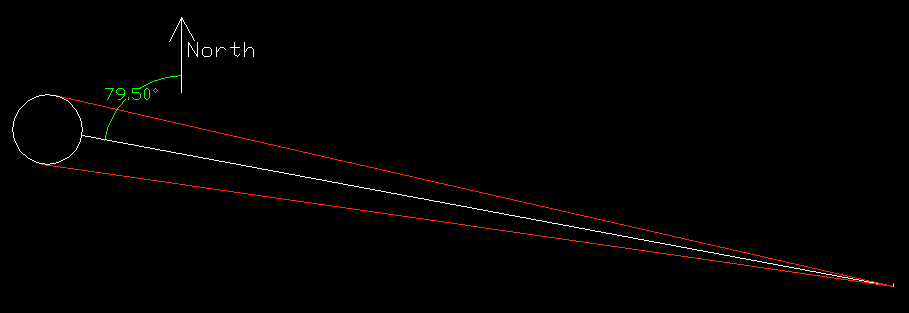
(Figure 4a. The 'knuckle joint' being about '3 o'clock')
The white line running just north of west right-to-left across the picture is the 1181.683 feet distance between St Saviour's (focal point near the bottom right corner) and the Globe (the white circle), angled 280.5 degrees clockwise from north (or, as labelled, 79.5 degrees anti-clockwise). The red lines are Hollar's sightings of the left and right side of the Globe: tangents of the playhouse circle converging on the stylus, and passing through the plane representing the sketch. Because the distance between the buildings is more than a thousand times the distance between the stylus and the plane representing the sketch, no detail of Hollar's topographical glass is visible in this figure, so the next one is a blow up of this one's bottom right corner.
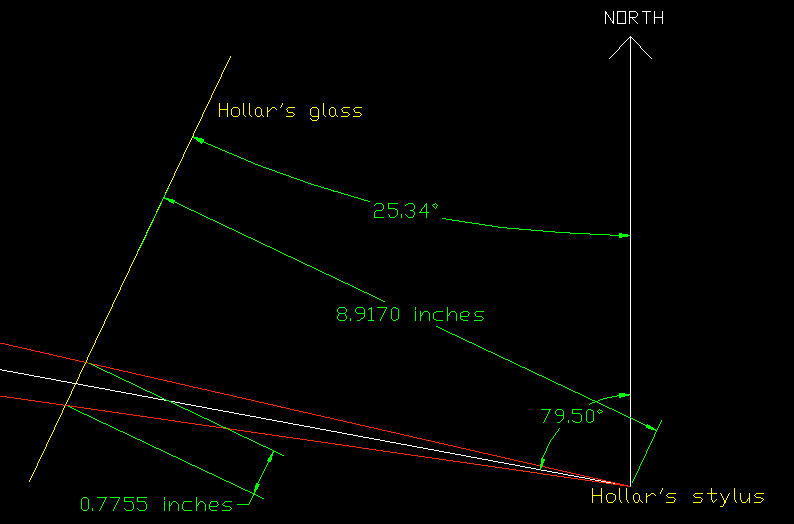
(Figure 4b. The size of the image on Hollar's instrument with the 'knuckle joint' being about '3 o'clock')
As before, the green lines are dimensions, the white line represents the 1181.683 feet to the Globe, and the red lines are sightings from the left and right sides of the Globe; the yellow line is Hollar's sketch. It should be noted that this picture comes not from a drawing but from a computer model, so the dimensioning numbers were produced by the computer from the objects in the model; the author did not enter them manually as labels. The author specified the objects thus: Hollar's sketch pointing 25.34 degrees east of north, the sketch 8.917 inches from the stylus, and the sighting lines extending from the existing model of the Globe, placed 1181.683 feet away. The crucial outcome figure is the 0.7755 inches (= 19.7 millimetres) that AutoCAD calculates as the distance between the two points where the left and right sightings of the Globe intersect Hollar's sketch: this should be the width of the Globe image in the extant sketch. About the size of the image on the sketch, Orrell wrote "The maximum [distance], for the outer sides of the lines marking the wall of the Globe, is 21.2mm; the open space between them is 20.8mm and the distance between their centres is 21.0mm" [52]. If the model accurately represents how the sketch was made, the 100-feet diameter ISGC Globe that makes a 19.7 millimetre image in the sketch is smaller than the theatre it is supposed to be a copy of, yet all objectors have argued for it being too large.
-
The 19.7 millimetre image is not far from the lower limit (20.8 millimetres) measured by Orrell from the sketch itself, so it is worth trying to move the Globe model around the fixed point of the 'knuckle joint' to see if alternative placings improve the fit between the computerized version of the procedure and the explanation given by Orrell. Figure 5a shows the playhouse placed so that the 'knuckle joint' is the most southerly point of the playhouse as seen from St Saviour's tower (the red sighting lines have been removed in this view) and Figure 5b shows the resulting geometry at Hollar's topographical glass.
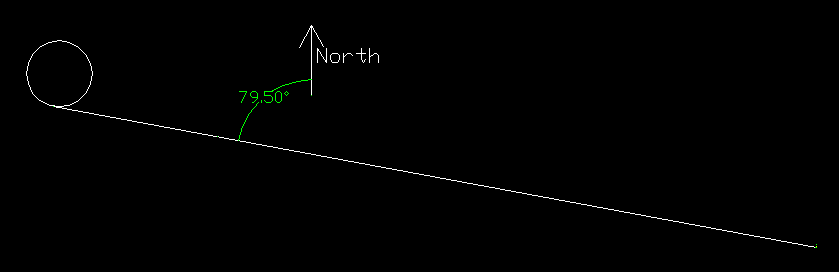
(Figure 5a. The 'knuckle joint' being about '6 o'clock')
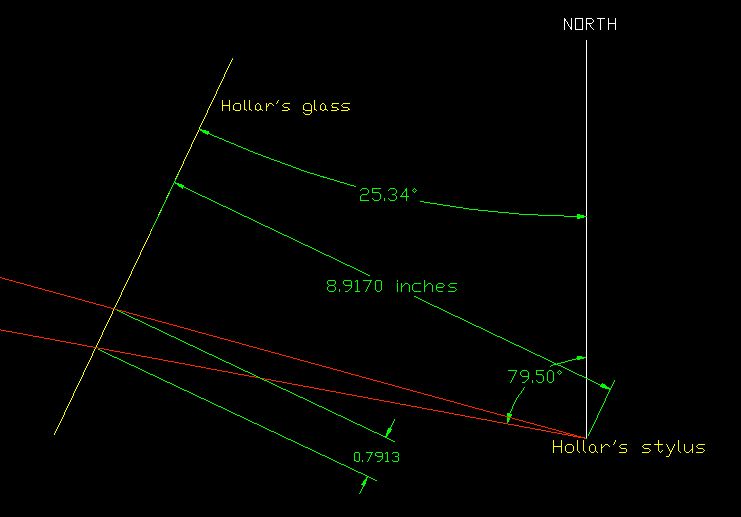
(Figure 5b. The size of the image on Hollar's instrument with the 'knuckle joint' being about '6 o'clock')
As can be seen, this arrangement produces an image that is 0.7913 inches (= 20.1 millimetres), which is closer still to Orrell's claimed 21 millimetre reading. The obvious next step is to try the opposite site, with the 'knuckle joint' near the top of the playhouse, as in Figure 6a and Figure 6b.
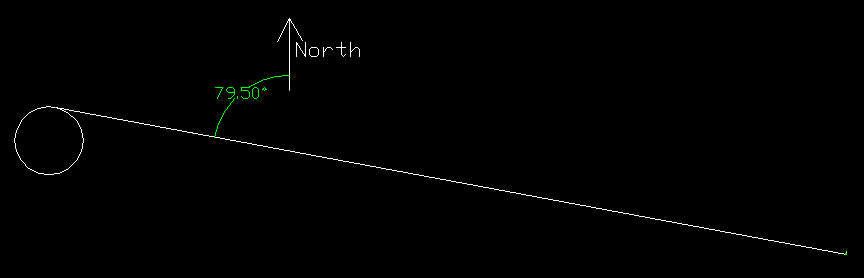
(Figure 6a. The 'knuckle joint' being about '12 o'clock')
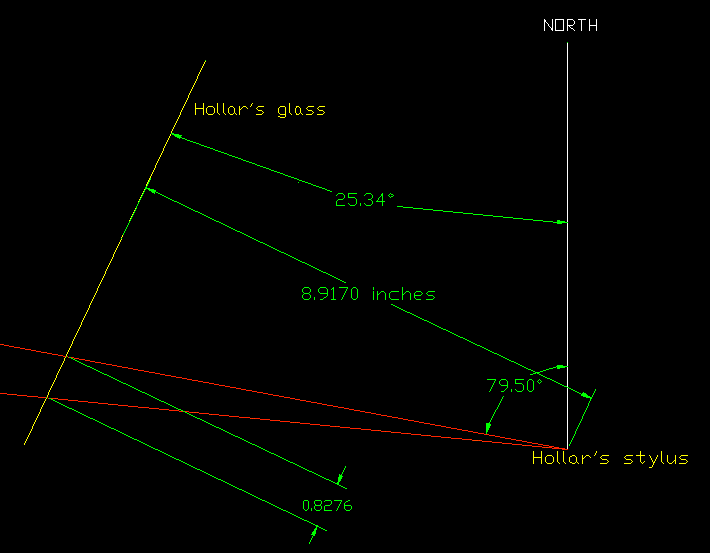
(Figure 6b. The size of the image on Hollar's instrument with the 'knuckle joint' being about '12 o'clock')
This yields an image 0.8276 inches, which is 21.02 millimetres and almost exactly what Orrell measured the Hollar image of the Globe to be. Finally, for the sake of completeness, it is worth seeing what size image is produced if we assumed that the 'knuckle joint' uncovered by the Museum of London Archaeological Service were on the far side of the Globe from St Saviour's, at about the '9 o'clock' position; this is shown in Figures 7a and 7b.
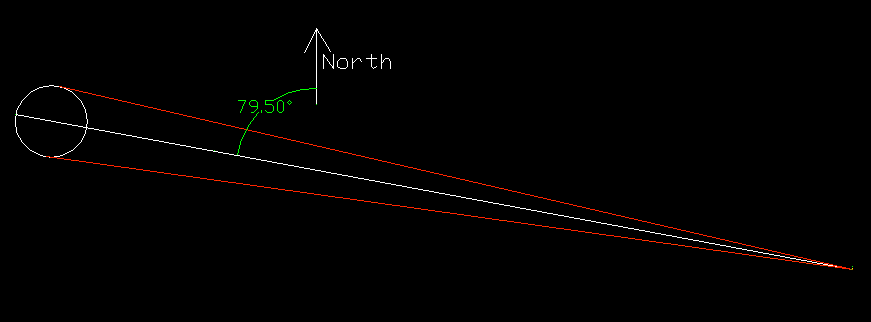
(Figure 7a. The 'knuckle joint' being about '9 o'clock')
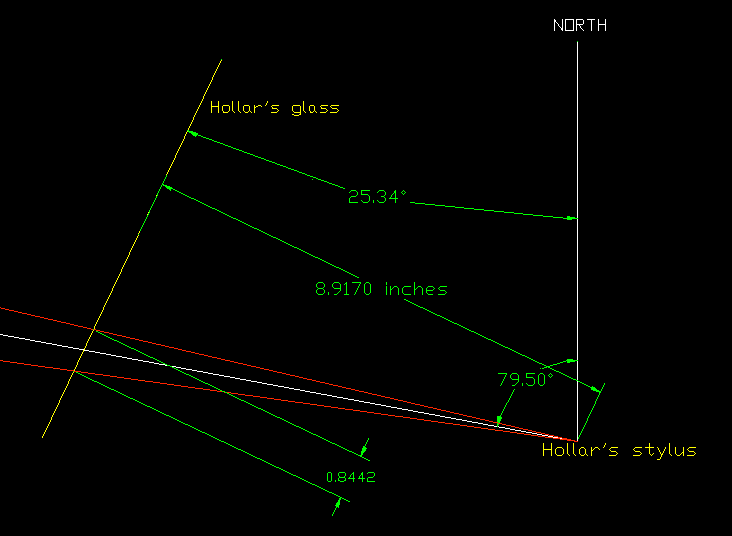
(Figure 7b. The size of the image on Hollar's instrument with the 'knuckle joint' being about '9 o'clock')
Now the image of the Globe is a little larger than Orrell's, 0.8442 inches being 21.44 millimetres.
Conclusion
-
Orrell's narrative of the making of the Hollar sketch can be modelled in a computer in a way that produces results close to, but significantly different from, those found by Orrell himself. It is difficult to know what to make of the differences, for the procedures in the computer modelling follow exactly this author's understanding of Orrell's description [53], the trigonometric version of which this author previously confirmed in an unpublished PhD thesis [54]. When The Quest for Shakespeare's Globe was published, the Globe foundations had not been uncovered and for the position of the site of the Globe Orrell had to rely on the work of W. W. Braines [55] and a map of Southwark drawn in about 1620 [56], which taken together Orrell thought "securely established [the location] within quite narrow limits" [57]. My reconstruction of the method by which Hollar made the sketch is highly sensitive to relatively small changes in the location of the Globe produced when we rotate it about the one firm datum, the 'knuckle joint' uncovered in 1989. Orrell was, of course, aware that precisely locating the Globe site was important, and after the excavation he wrote:
Now that the true location of the Globe is known, I have been able to use it as a datum for recalculating the angle of Hollar's plane intersection. The resultant small change in the orientation of the picture plane leads to a larger difference in the degree of anamorphosis affecting the Globe, whose diameter I now calculate at 97.61 ft., plus or minus two percent, a figure consistent with the 99 ft. diameter now proposed as a result of the site studies [58].
It is not entirely clear what Orrell meant here, for "the angle of Hollar's plane intersection" and "the orientation of the picture plane" can only refer to the angle of 25.34 degrees east of north to which Hollar's glass and its attached sketch were turned. Why should that change as a result of finding out where the Globe was? Orrell used 5 identifiable landmarks in the sketch -- the east gable of St Paul's, Bevis Bulmer's water tower, St Martin's Ludgate, Baynard's Castle/St Bride's, and the Savoy -- to establish his picture plane angle, although admittedly he had previously changed his reading from 25.25 degrees [59] to 25.34 degrees [60]. It is curious, then, that Orrell later claimed that a new fix for the site of the Globe should alter the picture plane angle, and he did not reveal by how much he thought it changed it.
-
In a private communication with the author, Orrell confirmed that his reducing figures for the overall size of the Globe -- 103.35 feet in his first explanation based on Hollar [61] to the 97.61 feet quoted above -- was indeed due to changes in his calculation of the angle of Hollar's glass, and went further:
But since then [the 1993 article cited above] I've had second thoughts: I have yet to see a fully reliable plan of the Museum of London dig, accurately orientated. On the present evidence it appears that we don't yet know precisely where the Globe remains were, nor exactly which way they pointed (an astonishing fact, but one readily checked if you compare the various plans issued by the Museum, which fail to agree with one another) [62].
The analysis summarized in this paper shows that knowing the precise location of the Globe is indeed crucial to interpreting Hollar's sketch, not because it affects the orientation of the instrument -- this is set by independent data -- but because it conditions the distance of the playhouse from the St Saviour's (nearer objects will produce larger readings) and also because the further away from the central ray of the instrument's glass a round object is placed, the greater the distorting effect of anamorphosis. This distortion is admirably explained by Orrell [63] but has been ignored here because our object is only to see if the image produced on our computerized sketch matches that on the real sketch; that the real and the virtual images give (equally) distorted representations of their subjects is beside the point.
In this analysis it was possible to recreate the essential datum of the Hollar sketch -- the 21 millimetre image of the Globe -- by precisely the means Orrell described, but only by giving an implausible interpretation of the foundations uncovered in 1989: that the 'knuckle joint' is on the north side of the playhouse somewhere near the 'noon' position on the clockface (as in Figures 6a and 6b), or else (the next closest fit) that it is on the west side of the playhouse somewhere near the '9 o'clock' position on the clockface (as in Figures 7a and 7b). It is not possible to move the Globe further than I have without entirely giving up on the 'knuckle joint' as part of the original building's foundations. In short, if the Hollar sketch was made the way Orrell described, the Globe was either not where the 1989 excavations seem to put it -- they cover only about 2% of the Globe site and are highly ambiguous -- or the Globe was not 100-feet across as Orrell thought. Perhaps the Hollar sketch was not made by the method described by Orrell, in which case we would again have to conclude that there is no reason to favour Orrell's 100-feet design. We remain limited by the principal evidence for the size of the Globe: the digital version of the Museum of London's drawings of the excavation, and the Hollar sketch, the making of which we can model in a computer. On this evidence, and by these procedures, the most we can say is that ISGC replica Globe is a reasonable approximation of the building it aims to represent, but its claim to that title is not clearly stronger than that of other designs rejected in its favour.
Notes
1 The author would like to acknowledge the financial support of the British Academy in the execution of the research presented in this paper, especially a £3,600 Small Research Grant for "An AutoCAD/VRML model of the Globe" awarded in April 2000. This money was used to pay for AutoCAD software and trips to research libraries that enabled the author to make an accurate computer model of the ISGC Globe, based on the published plans and architectural drawings archived by the Globe Research team at the ISGC Globe. For the latter the author is also indebted to Undine Concannon, the Globe archivist, and Jon Greenfield, the project's architect. At the Museum of London Archaeological Service, Nathalie Cohen, Kate Pollard, and Robin Densem provided invaluable assistance in connection with the AutoCAD drawing of the excavated foundations of the Globe.
2 Barry Day, This Wooden 'O': Shakespeare's Globe Reborn (London: Oberon, 1996), pp. 192-201.
3 John Orrell and Andrew Gurr, 'What the Rose Can Tell us', Times Literary Supplement, 4497 9-15 June (1989), 636, 649.
4 R. A. Foakes and R. T. Rickert, eds., Henslowe's Diary, Edited with Supplementary Material, Introduction and Notes (Cambridge: Cambridge University Press, 1961), pp. 9-13.
5 Julian M. C. Bowsher and Simon Blatherwick, 'The Structure of the Rose', in New Issues in the Reconstruction of Shakespeare's Theatre: Proceedings of the Conference Held at the University of Georgia, February 16-18, 1990, ed. Franklin J. Hildy (New York: Peter Lang, 1990), pp. 55-78.
6 John Orrell, 'Beyond the Rose: Design Problems for the Globe Reconstruction', in New Issues in the Reconstruction of Shakespeare's Theatre: Proceedings of the Conference Held at the University of Georgia, February 16-18, 1990, ed. Franklin J. Hildy (New York: Peter Lang, 1990), pp. 95-118.
7 Orrell, 'Beyond the Rose: Design Problems for the Globe Reconstruction' (p. 97).
8 Richard Hosley, 'The Shape and Size of the Second Globe', in The Third Globe: Symposium for the Reconstruction of the Third Globe Playhouse, Wayne State University, 1979, ed. C. Walter Hodges, S. Schoenbaum and Leonard Leone (Detroit: Wayne State University Press, 1981), pp. 82-107 (pp. 88-91).
9 Orrell, 'Beyond the Rose: Design Problems for the Globe Reconstruction' (pp. 99-100).
10 John Orrell, 'Peter Street at the Fortune and the Globe', Shakespeare Survey, 33 (1980), 139-51; John Orrell, The Quest for Shakespeare's Globe (Cambridge: Cambridge University Press, 1983); John Orrell, The Human Stage: English Theatre Design, 1567-1640 (Cambridge: Cambridge University Press, 1988).
11 Orrell, 'Peter Street at the Fortune and the Globe' (p. 146).
12 Orrell & Gurr, 'What the Rose Can Tell us'.
13 Orrell, 'Beyond the Rose: Design Problems for the Globe Reconstruction' (pp. 100-1).
14 Orrell, 'Beyond the Rose: Design Problems for the Globe Reconstruction' (pp. 101-7).
15 Orrell, 'Beyond the Rose: Design Problems for the Globe Reconstruction' (pp. 107-9).
16 Peter McCurdy, 'Shakespeare's Globe Theatre: The Construction of Two Experimental Bays in June 1992', in The Timber Frame--From Preservation to Reconstruction: Papers Presented at the International Council on Monuments and Sites UK Timber Seminar Held at Haydock Park on 26 April 1993, ed. F. W. B. Charles (London: Icomos UK, 1993), pp. 1-20.
17 Foakes & Rickert, eds., Henslowe's Diary, Edited with Supplementary Material, Introduction and Notes, p. 307.
18 Simon Blatherwick and Andrew Gurr, 'Shakespeare's Factory: Archaeological Evaluations on the Site of the Globe Theatre at 1/15 Anchor Terrace, Southwark Bridge Road, Southwark', Antiquity, 66 (1992), 315-33 (pp. 319-23).
19 Blatherwick & Gurr, 'Shakespeare's Factory' (p. 321).
20 Blatherwick & Gurr, 'Shakespeare's Factory' (p. 327).
21 Blatherwick & Gurr, 'Shakespeare's Factory' (p. 326).
22 Martin Clout, 'The Evaluation and Scheduling of the Globe Theatre Estate', London Archaeologist, 6.15 (1992), 407-14.
23 Blatherwick & Gurr, 'Shakespeare's Factory' (p. 330).
24 Blatherwick & Gurr, 'Shakespeare's Factory' (p. 331).
25 Blatherwick & Gurr, 'Shakespeare's Factory' (pp. 332-3).
26 Franklin J. Hildy, '"If You Build it They Will Come": The Reconstruction of Shakespeare's Globe Gets Underway on the Bankside in London', Shakespeare Bulletin, 10.3 (1992), 5-9.
27 Hildy, '"If You Build it They Will Come"' (p. 7).
28 Hildy, '"If You Build it They Will Come"' (p. 7).
29 Andrew Gurr, 'Evidence for the Design of the Globe: The Report of a One-day Seminar Held on 10 October 1992 at Pentagram in London', in The Design of the Globe, ed. Andrew Gurr, Ronnie Mulryne and Margaret Shewring (London: International Shakespeare Globe Centre, 1993), pp. 1-19 (p. 6).
30 Gurr, 'Evidence for the Design of the Globe' (pp. 8-9).
31 Gurr, 'Evidence for the Design of the Globe' (p. 10).
32 Gurr, 'Evidence for the Design of the Globe' (pp. 11-4).
33 Those who do are most welcome to copies of the author's model of the ISGC Globe and to the MoLAS model of the foundations in order to replicate the processing described in this paper. The author, an employee of the Education Department of ISGC Limited attempting to be entirely neutral about the interpretation of the evidence, would welcome others' replication of the procedures described in this paper, with a view to corroborating or contradicting its conclusion.
34 Orrell, 'Peter Street at the Fortune and the Globe'.
35 John Orrell, 'Wenceslaus Hollar and the Size of the Globe Theatre', in The Third Globe: Symposium for the Reconstruction of the Third Globe Playhouse, Wayne State University, 1979, ed. C. Walter Hodges, S. Schoenbaum and Leonard Leone (Detroit: Wayne State University Press, 1981), pp. 108-16.
36 Orrell, 'Wenceslaus Hollar and the Size of the Globe Theatre' (pp. 109-10).
37 Orrell, 'Wenceslaus Hollar and the Size of the Globe Theatre' (pp. 110-1).
38 Orrell, 'Wenceslaus Hollar and the Size of the Globe Theatre' (p. 115).
39 Orrell, 'Wenceslaus Hollar and the Size of the Globe Theatre' (p. 116).
40 Orrell, The Quest for Shakespeare's Globe (Cambridge: Cambridge University Press, 1983).
41 Orrell, The Quest for Shakespeare's Globe, p. 102.
42 Orrell, 'Wenceslaus Hollar and the Size of the Globe Theatre' (p. 116n9)
43 Orrell, The Quest for Shakespeare's Globe, p. 89.
44 Orrell, The Quest for Shakespeare's Globe, p. 104
45 Orrell, The Quest for Shakespeare's Globe, p. 106.
46 Orrell, The Quest for Shakespeare's Globe, p. 105.
47 Orrell, The Quest for Shakespeare's Globe, pp. 101-2.
48 Orrell, The Quest for Shakespeare's Globe, p. 125.
49 Orrell, The Quest for Shakespeare's Globe, pp. 89-90.
50 The author would like to acknowledge the assistance of Tim Fitzpatrick of University of Sydney in finding precise figures for the distance and bearing from the Globe to the tower of St Saviour's Church and the height of the tower. Peter Draper of Birkbeck College, University of London, kindly confirmed (private email communication, 5 November 1999) that alterations to the tower since the making of Hollar's sketch have not altered the height above ground of the platform at the top of the tower on which Hollar stood.
51 John Ronayne, 'Totus Mundus Agit Histrionem [The Whole World Moves the Actor]: The Interior Decorative Scheme of the Bankside Globe', in Shakespeare's Globe Rebuilt, ed. J. R. Mulryne, Margaret Shewring and Andrew Gurr (Cambridge: Cambridge University Press, 1997), pp. 121-46 (p. 121).
52 Orrell, The Quest for Shakespeare's Globe, p. 101.
53 Orrell, The Quest for Shakespeare's Globe, pp. 84-107.
54 Gabriel Egan, Two 'Transitional' Late Plays at the Globe: An Evaluation of the Scholarship of Globe Reconstruction and Its Bearing on the Original Staging of Shakespeare's The Winter's Tale and Cymbeline, Unpublished PhD thesis, University of Birmingham UK, 1997, Appendix 4, pp. 476-503.
55 W. W. Braines, The Site of the Globe Playhouse, Southwark, 2nd edition (London: Hodder and Stoughton, 1924).
56 Irwin Smith, Shakespeare's Globe Playhouse: A Modern Reconstruction in Text and Scale Drawings, Introd. James G. McManaway (New York: Charles Scribner's Sons, 1956), Plate 16.
57 Orrell, The Quest for Shakespeare's Globe, p. 63.
58 John Orrell, 'The Accuracy of Hollar's Sketch of the Globe', Shakespeare Bulletin, 11.2 (1993), 5-9 (9n3).
59 Orrell, 'Wenceslaus Hollar and the Size of the Globe Theatre' (pp. 114-5).
60 Orrell, The Quest for Shakespeare's Globe, pp. 80-81.
61 Orrell, 'Wenceslaus Hollar and the Size of the Globe Theatre' (pp. 115-6).
62 John Orrell, 'Revising the Width of the Globe as Shown in Hollar's Sketch for the "Long View"': Email Correspondence to Author 4 April, 1997.
63 Orrell, The Quest for Shakespeare's Globe, pp. 96-100.

Works Cited
Blatherwick, Simon, and Andrew Gurr. 'Shakespeare's Factory: Archaeological Evaluations on the Site of the Globe Theatre at 1/15 Anchor Terrace, Southwark Bridge Road, Southwark', Antiquity, 66 (1992), 315-33.
Bowsher, Julian, and Simon Blatherwick. 'The Structure of the Rose', in New Issues in the Reconstruction of Shakespeare's Theatre: Proceedings of the Conference Held at the University of Georgia, February 16-18, 1990, ed. Franklin J. Hildy (New York: Peter Lang, 1990), pp. 55-78.
Braines, W. W. The Site of the Globe Playhouse, Southwark. 2nd edition. London: Hodder and Stoughton, 1924.
Day, Barry.This Wooden 'O': Shakespeare's Globe Reborn. London: Oberon, 1996.
Egan, Gabriel. Two 'Transitional' Late Plays at the Globe: An Evaluation of the Scholarship of Globe Reconstruction and Its Bearing on the Original Staging of Shakespeare's The Winter's Tale and Cymbeline, Unpublished PhD thesis. University of Birmingham UK, 1997.
Foakes, R. A., and R. T. Rickert, eds. Henslowe's Diary, Edited with Supplementary Material, Introduction and Notes. Cambridge: Cambridge University Press, 1961.
Gurr, Andrew. 'Evidence for the Design of the Globe: The Report of a One-day Seminar Held on 10 October 1992 at Pentagram in London', in The Design of the Globe, ed. Andrew Gurr, Ronnie Mulryne and Margaret Shewring (London: International Shakespeare Globe Centre, 1993), pp. 1-19.
Hildy, Franklin J. '"If You Build it They Will Come": The Reconstruction of Shakespeare's Globe Gets Underway on the Bankside in London', Shakespeare Bulletin, 10.3 (1992), 5-9.
Hosley, Richard. 'The Shape and Size of the Second Globe', in The Third Globe: Symposium for the Reconstruction of the Third Globe Playhouse, Wayne State University, 1979, ed. C. Walter Hodges, S. Schoenbaum and Leonard Leone (Detroit: Wayne State University Press, 1981), pp. 82-107.
McCurdy, Peter. 'Shakespeare's Globe Theatre: The Construction of Two Experimental Bays in June 1992', in The Timber Frame--From Preservation to Reconstruction: Papers Presented at the International Council on Monuments and Sites UK Timber Seminar Held at Haydock Park on 26 April 1993, ed. F. W. B. Charles (London: Icomos UK, 1993), pp. 1-20.
Orrell, John. 'Beyond the Rose: Design Problems for the Globe Reconstruction', in New Issues in the Reconstruction of Shakespeare's Theatre: Proceedings of the Conference Held at the University of Georgia, February 16-18, 1990, ed. Franklin J. Hildy (New York: Peter Lang, 1990), pp. 95-118.
Orrell, John. 'Peter Street at the Fortune and the Globe', Shakespeare Survey, 33 (1980), 139-51.
Orrell, John. 'The Accuracy of Hollar's Sketch of the Globe', Shakespeare Bulletin, 11.2 (1993), 5-9.
Orrell, John. The Quest for Shakespeare's Globe. Cambridge: Cambridge University Press, 1983.
Orrell, John. The Human Stage: English Theatre Design, 1567-1640. Cambridge: Cambridge University Press, 1988.
Orrell, John. 'Wenceslaus Hollar and the Size of the Globe Theatre', in The Third Globe: Symposium for the Reconstruction of the Third Globe Playhouse, Wayne State University, 1979, ed. C. Walter Hodges, S. Schoenbaum and Leonard Leone (Detroit: Wayne State University Press, 1981), pp. 108-16.
Orrell, John, and Andrew Gurr. 'What the Rose Can Tell us', Times Literary Supplement, 4497 9-15 June (1989), 636, 649.
Ronayne, John. 'Totus Mundus Agit Histrionem [The Whole World Moves the Actor]: The Interior Decorative Scheme of the Bankside Globe', in Shakespeare's Globe Rebuilt, ed. J. R. Mulryne, Margaret Shewring and Andrew Gurr (Cambridge: Cambridge University Press, 1997), pp. 121-46.
Smith, Irwin. Shakespeare's Globe Playhouse: A Modern Reconstruction in Text and Scale Drawings, Introd. James G. McManaway. New York: Charles Scribner's Sons, 1956.